Borrowing Against 2027
Four NFL teams created nearly $130 million of cap room this spring without cutting anyone. Here is the bill they wrote, who signed it, and why the incentives guarantee they will do it again.

In February, Kansas City was more than $50 million over the projected salary cap. It fixed $43.56 million of that in a single afternoon without releasing one player.
The move was a restructure of Patrick Mahomes’ contract. The Chiefs converted $44.05 million of his 2026 base salary plus a $10.4 million roster bonus into a fully guaranteed roster bonus. His 2026 cap charge fell from $78.214 million to $34.65 million.
Mahomes did not take less. He took the same money sooner. The team did not spend less. It just told the cap a different story about when the spending happened.
That is the entire mechanism. Base salary counts in the year it is paid. Bonus money prorates in equal slices across the contract, to a maximum of five years. Convert one into the other and this year’s number collapses while every future year swells.
Four quarterbacks carried this spring’s heaviest lifting, and the pattern is identical in each case.
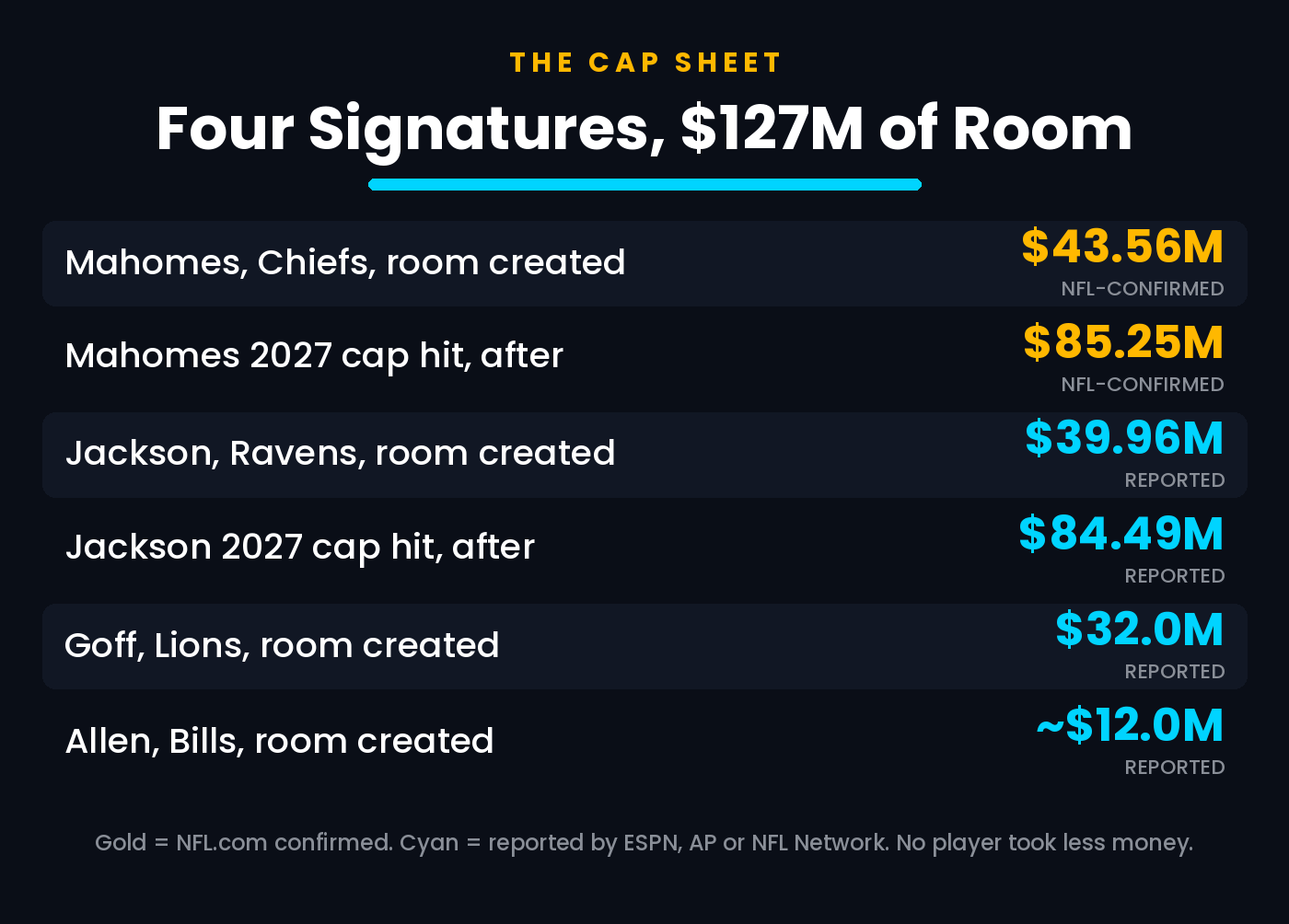
Roughly $127 million of 2026 room, created by four signatures. No player was cut for it. No owner spent a dollar less.
The Ravens’ version is the most instructive, because it shows where the money physically goes. Baltimore triggered an automatic clause converting most of Lamar Jackson’s $51.3 million base salary into signing bonus, spread across four seasons including the two void years already written into his deal.
A void year is a season added to the end of a contract that nobody expects the player to play. It is not a loophole anyone hides. It is printed in the document. Its only function is to give bonus proration somewhere to sit, because proration must be spread across contract years and a contract that ends in 2027 cannot spread money into 2028.
The catch is what happens when the void year arrives. The contract terminates, the player becomes a free agent, and every dollar parked in those fake seasons accelerates onto the current cap immediately. The money does not vanish when the years do.
Add up enough of that and you get the table nobody puts in a press release.
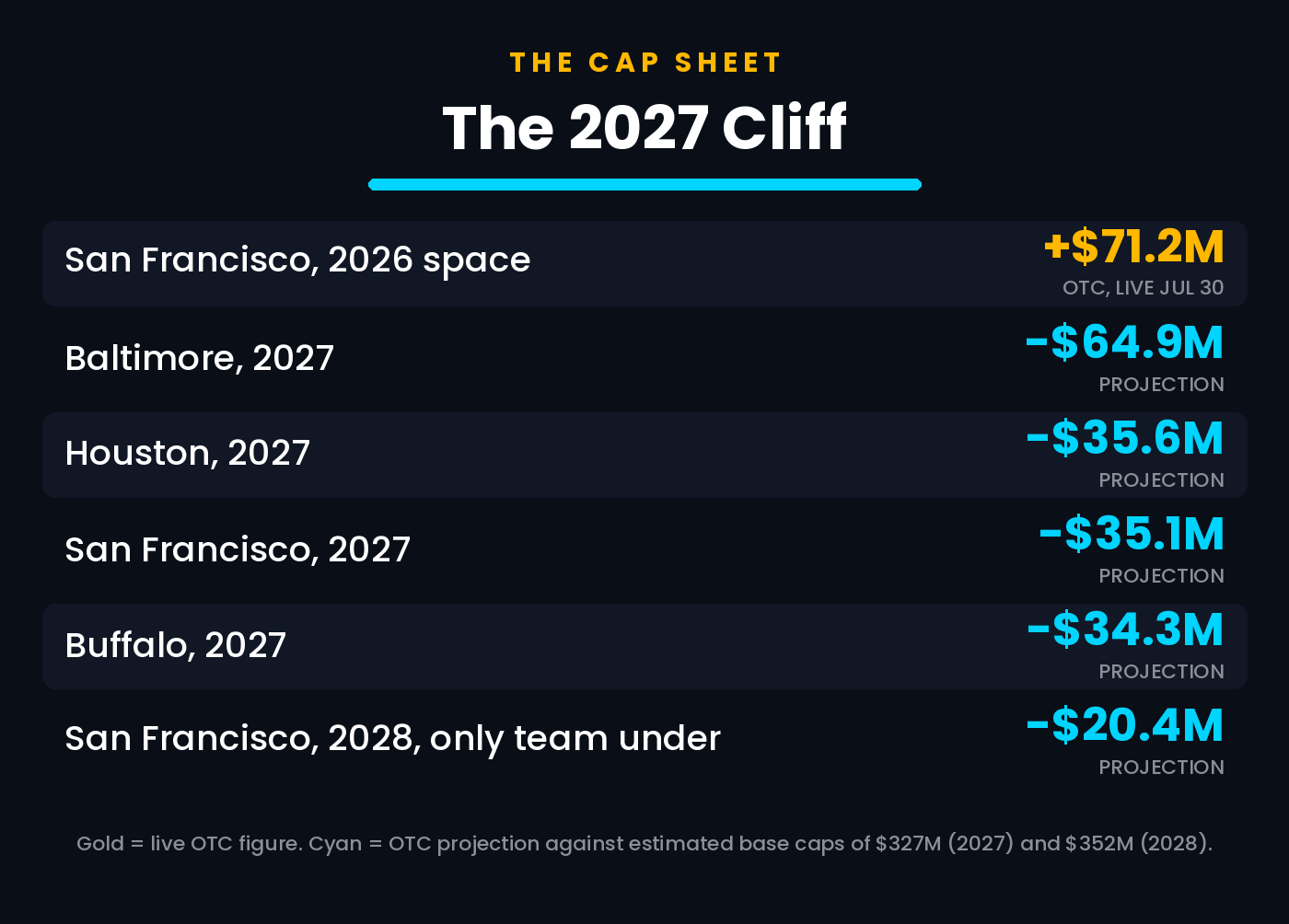
The 2027 and 2028 base caps in that table are Over The Cap projections, $327 million and $352 million, not announced league figures. Treat the direction as solid and the decimals as estimates.
Even with that caveat the shape is unambiguous. San Francisco has more room today than any team in football and is the only franchise projected underwater two years out. Baltimore is projected roughly $64.9 million over the 2027 cap before signing a single player, and the cap is rising by more than twenty million dollars a year while they do it.
The obvious question is why any competent front office would build that. The answer is that the incentives are not misaligned by accident. They are misaligned by structure, and this is one of the rare cases where a game-theory reading actually earns its place rather than being decoration.
Consider who is at the table. A general manager’s median tenure is measured in a handful of seasons. The contract he is restructuring runs longer than his job security. A coach’s window is shorter still. The owner is the only party with a genuinely long horizon, and the owner’s cash outlay is unchanged either way, since a restructure moves cap charges, not payments.
So the decision-maker who takes the cost is not the decision-maker who takes the benefit. Push a charge into 2028 and the person who eats it is quite possibly a successor. Refuse to push it, field a thinner roster, and you may not be employed long enough to enjoy your clean books.
Now add the competitive layer. If every rival is borrowing against future caps to sign a pass rusher this August, a team that abstains does not get rewarded for prudence. It gets a worse roster in the same division, judged against opponents who bought help on credit. The prudent move is only prudent if everyone else is prudent too, and nobody can commit to that.
That is a straightforward prisoner’s dilemma, and it resolves the way those usually do. Everyone defects. The league-wide result is a cap system in which teams collectively spend against future years as fast as the cap rises, which is exactly the pattern the table above shows.
There is one genuine brake, and almost nobody talks about it. The CBA does not only set a maximum. Article 12, Section 9 requires a guaranteed minimum team cash spending of 90% of the salary caps across the 2024 to 2026 period. Any shortfall is paid on or before the following September 15, directly to the players who were on that roster, allocated by the union. If a team refuses, the league pays it on the team’s behalf.
That is the rule that makes all the accounting theater tolerable. Cap charges can be pushed, split, prorated and parked in seasons that do not exist. Cash cannot. Whatever a team does with the timing, the money still has to leave the building, and 2026 is a settle-up year.
Which leaves a cleaner way to read every cap headline you will see between now and the September 9 opener. The salary cap is not a limit on what NFL owners pay their players. It is a limit on when they are allowed to admit it.
-The Cap Sheet