The Cap Is a Calendar
The NFL salary cap does not decide what a team spends. It decides which year the spending shows up, and one franchise just proved how far that goes.

Miami will spend about $117.0 million on its roster this season. It will spend about $179.2 million on players who are no longer on it.
That is not a typo and it is not a penalty. It is the largest dead-money figure in NFL history, and every dollar of it is money the Dolphins already handed to people who play somewhere else now.
Dead money is the most misunderstood number in football, so start with what it actually measures. When a team signs a player it usually pays a large bonus up front, in cash, immediately. The salary cap does not charge the team for that cash all at once. It spreads the charge across the life of the contract, up to five years.
So the player is paid on one calendar and the team is charged on another. Dead money is just the gap between them. Cut a player and the cash is long gone, but the unbilled cap charges are still queued up, and releasing him drags every remaining year onto the current books at once.
Miami did that sixteen times in one offseason.
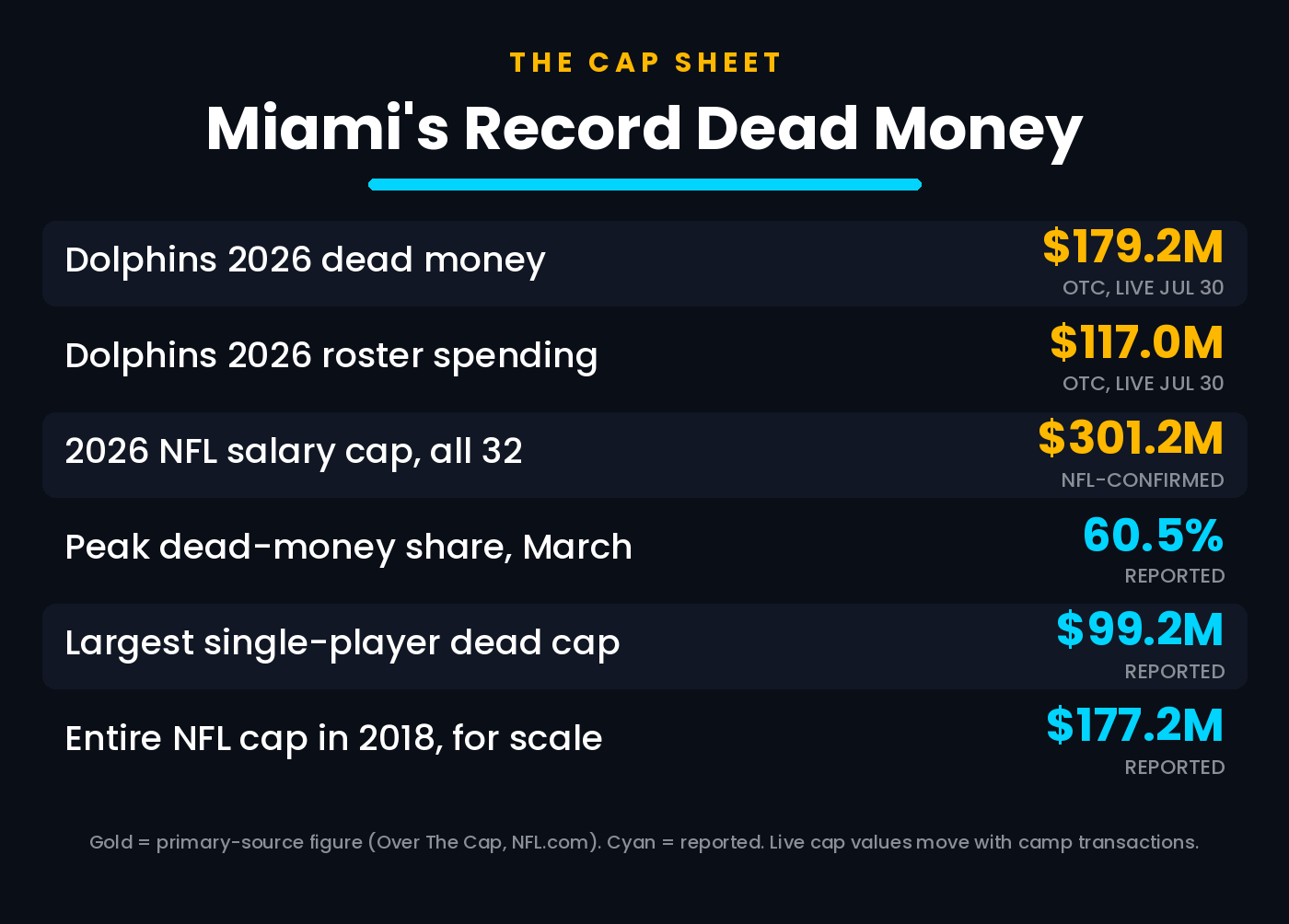
Look at the last two rows together. Miami’s dead-money bill at its March peak, $182.29 million, was larger than the entire salary cap the whole league operated under in 2018. One team’s list of departed players outweighs what a full roster used to cost.
The single largest line is Tua Tagovailoa at $99.2 million, the biggest dead cap hit any player has ever produced. Miami softened it using a rule most fans have never heard of. A team may designate up to two of its pre-June 1 releases for post-June 1 cap treatment, which splits the charge across two league years instead of one. So Miami takes $55.4 million this year and $43.8 million next year.
Notice what that rule does and does not do. It does not reduce the bill by a dollar. It only decides which season absorbs it, which usually means pushing half of it into a year the current general manager may not be around to manage.
Cleveland shows the other edge of the same blade. Deshaun Watson counts about $40.96 million against the Browns’ cap in 2026. His base salary is $1.3 million. Almost the entire number is old bonus proration, money the team paid years ago.
Release him before June 1 and the charge does not fall, it climbs to roughly $127.17 million, because every future year of proration accelerates into this one. Cutting him is about $86.21 million worse than keeping him.
That is the part worth sitting with. The Browns are not keeping that contract because they value the player at $41 million. They are keeping it because the accounting makes departure more expensive than employment. A large NFL contract is not really a commitment to a person. It is a commitment to a schedule of charges, and the schedule outlives the relationship.
Which is why “cap space” is such a misleading phrase. It sounds like savings. It is closer to unbooked calendar. San Francisco leads the league with about $71.2 million of it right now, and against Over The Cap’s projected future caps the 49ers are the only team in football below zero in 2028.
None of this is cheating and none of it is unusual. It is the predictable result of a system where teams can always move a charge forward and can never move it away. Every restructure, every void year, every post-June 1 designation is the same trade: relief now, a bigger number later, and someone else holding the invoice.
On Friday I am going to put real figures on the “later” half of that trade, including the four teams already projected over the 2027 cap before they sign a single player.
-The Cap Sheet