Baseball's Toll Booth
MLB never capped spending. It put a price on it, and the price is up for renewal.

Baseball is the only major North American sport without a salary cap. This is usually described as a loophole, a sign that the richest teams can simply buy whatever they want. The reality is more interesting. Baseball did cap spending. It just did it with a price instead of a wall, and this weekend, as contenders line up for Monday’s trade deadline, that price is doing exactly what it was designed to do.
The price has a name: the Competitive Balance Tax. For 2026 it starts at 244 million dollars. A team can spend past that line, but every dollar above it carries a tax, and the tax gets steeper the further and the longer a team goes over. First year over, 20 percent. Second consecutive year, 30 percent. Three years or more, and the rate hits 50 percent, with surcharges stacking on top at tiers of 264, 284 and 304 million dollars. Owners talk about the line the way a driver talks about a toll they resent but pay. Most treat it as a ceiling they would rather not break.
That single number quietly shapes the entire deadline. To see how, follow the money through one trade.
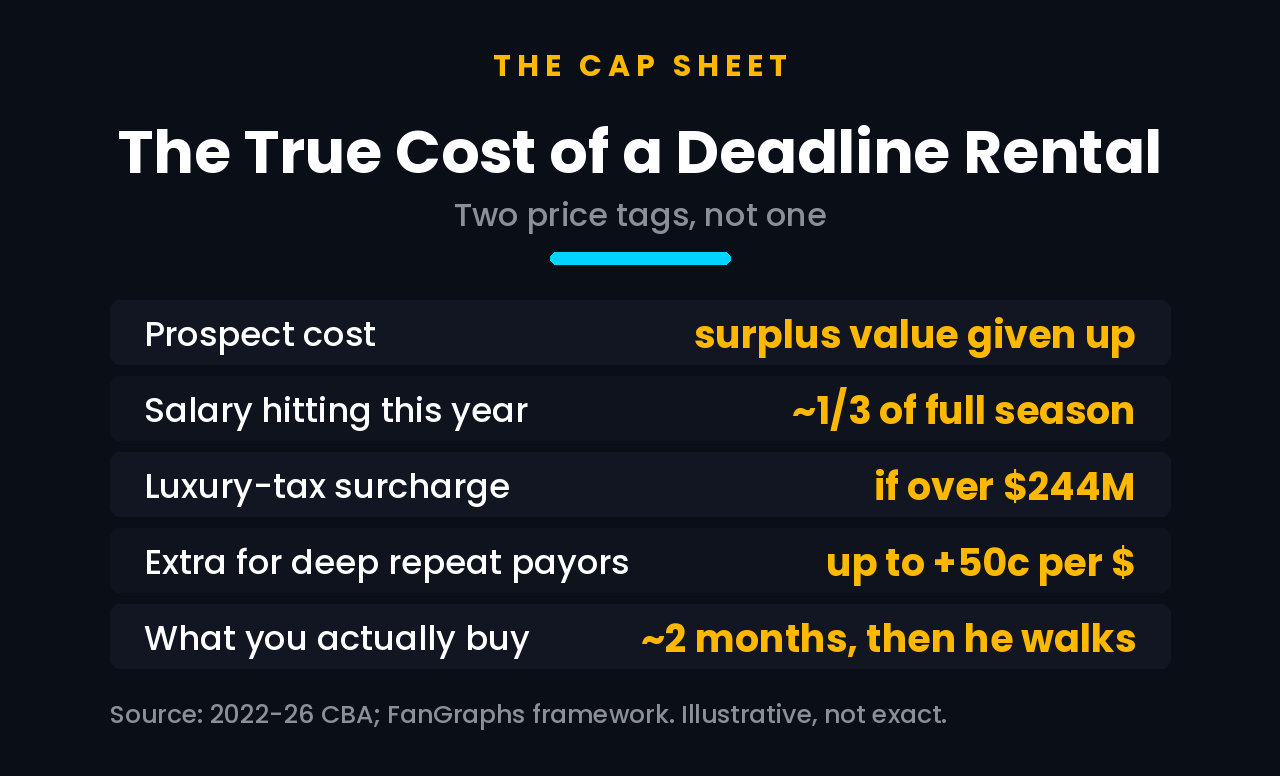
A contender decides it needs a bat for the stretch run. The best one available is a rental, a player headed for free agency who will be gone in the winter. Because the buyer only gets two months, the price in prospects is lower than for a comparable player under long-term control. That is the first rule of the deadline: you are paying for time, and two months is a discount. Control is what actually costs. The biggest prospect hauls every year go not for the rentals but for the young stars signed for three or four more seasons, because the buyer is getting years, not weeks.
But the prospect price is only half the invoice. The other half is the tax. If the buying team is already over 244 million dollars, the rental’s salary is taxed on top of everything it gives up in talent. Only about a third of a full-season salary lands on the books at an August deadline, which sounds cheap, until you remember it is taxed. For a repeat payor deep over the line, the effective cost of that rental can run well above the number on the contract.
Now the obvious question. If a rental costs prospects and a tax bill, and you lose the player in October, why does anyone do it?
Because the thing being bought is not the player. It is a playoff berth, and a playoff berth is worth a fortune. Extra home postseason games at premium prices, national television exposure, a deeper run with the revenue and the franchise-value halo that come with it. The deadline is the only in-season window to buy those wins, and there is no way to add them in September from outside the building. So a team on the edge of the playoffs will pay a premium, because the marginal win is worth more to them than the prospect is worth to anyone else.
This is where the incentives get genuinely interesting, because every contender faces the same math at the same moment, and that turns the deadline into a bidding war none of them can sit out. If your rivals are all buying wins and you are not, you fall behind at the one moment you can least afford to. So even a team that would rather keep its prospects gets pulled into the market. The rational move for each club, taken together, produces exactly the escalating overpay that makes fans call general managers reckless every single year. They are not reckless. They are trapped in the same auction, and the auction only opens once.
The luxury tax sits on top of all of this as the one brake. It does not stop a desperate contender, but it raises the cost of every win bought over the line, and it makes the richest teams think twice before stacking rental on rental. That is the whole design: not to forbid spending, but to price it, so that the teams with the most money at least feel the marginal cost of using it.
Which brings us to why this particular deadline is worth marking. This is the last one under the current rules.
The collective bargaining agreement that created this version of the tax expires after the 2026 season. The owners are widely expected to push for a real salary cap in the next deal, a hard ceiling rather than a toll, and the players have resisted exactly that for roughly half a century, since the fights that built the modern players’ union. Nobody can tell you today how it ends. What is clear is that the framework pricing every trade this week, the 244 million dollar line and the escalating tax above it, is itself up for renegotiation the moment the season ends. Treat any confident prediction of a cap, or a lockout, with suspicion; what is verifiable is the expiration and the well-documented positions on each side, not the outcome.
So watch the deadline this weekend with that frame in mind. Every rental that moves, every prospect that changes hands, every contender that grits its teeth and pays the tax, is being priced by a system that may look completely different a year from now. The players get the headlines. The 244 million dollar line, and the fight coming over it, is the business.
Baseball never actually capped spending. It put a price on it. And this winter, for the first time in a long time, that price goes back on the negotiating table.
-The Cap Sheet
Great explanation of why the trade deadline is really an economics problem, not just a baseball one. I especially liked the point that teams aren't simply buying players—they're buying incremental wins and playoff probability. That perspective makes many of the seemingly expensive deadline deals look much more rational.